

FOR WRITERS
The decision to give up the traditional publishing route was taken after a great deal of thought. But what’s it really like going it alone? Multi-genre authors Lexi Miles and A.B. Funkhauser tell all in a candid Q&A.
1.
You worked within the perimeters of a traditional publisher but opted to go the indie route after the fact. What shaped your decision?
 AB: Publishers, large and small, are like any other organization. They have guidelines and rules to follow. You need those, especially when you’re starting out and really don’t know what you’re doing. Friends will call you out on things, and you say to yourself “do they really know?” When your fellow authors at the publisher and the publishing team call you out, you listen because it’s part of the exercise, part of belonging, part of learning.
Again, publishers are like all other organizations. Think in terms of a condo association or even a cemetery. (I’m a mortician so I can’t resist including the graveyard.) A condo has rules about what you can and cannot put on the balcony. A cemetery has rules about what kind of florals you place and when they must be removed. Same with the publisher. A publisher will have rules about covers; how they’re supposed to look, how many colors are permitted, what kind of fonts are allowed. This is because the publisher wants to achieve a specific look for its brand. There’s nothing wrong with that. It’s all agreed upon at the time of signing.
Indies have the freedom to write their own rules about content, layout, and cover design. I wanted to try that for myself. However, my biggest caution to authors who want to try this is that they not jump in “boots first” but do their research before anything else. It’s a lot of work being your own publisher and promoter. It can get you down if you don’t know what to expect.
 Lexi: I felt constricted in many ways from cover art, release dates, and overall content. I also felt like I wanted better promotion for my work and wanted to release more works (not according to the houses allotted schedule). There are a lot of options on every front when you have more freedom.
2.
What are some of the pluses that come with independence?
 Lexi: I am what you call a hybrid author (both traditional and indie). With more independent publishers you have a lot more control over the details of your books. From length to content of the story. Yes, I still adhere to the guidelines of mainstream publishers and work with editors that do the same. Let me offer an example. As a romance author if I don’t want the standard girl meets boy and boy rescues girl scenario, I can have a story that is slightly more imaginative and realistic. I can say that they have a meet cute and she is already strong on her own and he’s not emotionally unavailable (aka robotic). They both meet challenges, but their love and support for each other helps them to conquer them. (Make no mistake, I do love those types of stories. I just like it to have more dimensions.)
 AB: The same pluses that come with being your own boss. You can show up to work when you want. You can choose not to work when you want. I tend to go hard when working on a project. From concept to finished manuscript to publishing to marketing. It can be a grind. There are so many theories out there about how often to publish, how best to affect the algorithms. I did that for three years at the end of which time I had to stop for almost a year. I needed to set a new pace for my work and for me as a person. I’m doing that now. It’s wonderful.
3.
Is there anything you miss about traditional publishing?
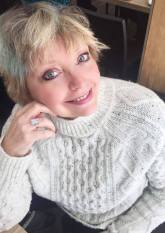 AB: I miss the team and the camaraderie. From the moment I signed, they were all there ready to field my untutored questions and reassure me when I got lost. As an indie, I felt like a group of one for a long time, but over time I’ve found other like-mindeds; other indies working toward the same goal: generating quality work and getting it out there. I have peeps again. I don’t feel alone at all.
 Lexi: With traditional publishers you have their audience built in. When you release your sales are more predictable, you are releasing to readers who know and trust their brand. Also, in most cases editors come with publishers. The tricky part there is finding one that works well with you and understands the voice of your story. I have a professional editor that I work with either way, so for me I don’t lose anything.
4.
Some indies create their own imprint or use smaller more independent publishers. Can you tell us why you did that?
 Lexi: First, people instantly look for publishers and imprints. It tends to signal quality of work and indicates a more professional work. Two, the freedom. I like being able to control the various aspects of my work and when you go that route you have complete creative freedom. That is an incredibly freeing feeling. That makes me confident to release all of my work because it is the exact voice I want out there.
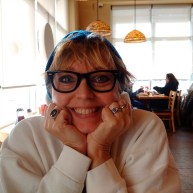 AB: One of the things I noticed on the book fair circuit was that potential readers would turn the book over and then say, “Oh, you’re independent.” The first couple of times it happened, I took it as an invitation to sell my virtues. The next time it happened, I asked the person what they were looking for and they said, “the publisher.” What is the publisher on the back of a book? It’s the imprint. My imprint is real; it’s registered in my country of origin and all my promo materials carry it plus the Independent Author Seal I designed. But I find having the imprint logo gets me past the first hurdle in a face to face. Rather than say “Oh, you’re indie” they say “Cool” or “What?” and then we can talk about the books. It’s a great icebreaker.
5.
What advice do you have for authors who wish to follow your example?
 AB: If you are already with a publisher, you must ask yourself why you want to DIY and then be prepared to do the research. Do you: know how to format a book; design covers; format your book into all formats (there are a few); know a good printer for your paperbacks; need to hire a professional editor or a professional cover designer; have a budget that can cover all your wants v. your needs; know how to use the advertising features across the platforms; understand the algorithms; have resource people who can guide you? And so on. I don’t want to mislead. It’s daunting.
 Lexi: First, write the book. Second, spend time editing so that it is a high quality book. Third, learn the ins and outs of what you need to do to publish it (formatting/covers), protect your work, and promote it. And finally, GO FOR IT!
6.
What one thing (or things) did you change that leveled up your writing?
 Lexi: I am always looking for new ways to level up my writing.
One, I write daily for at least an hour or more. This helps me to stay in a great groove while writing and to get a lot of high quality content in each day.
Two, after writing a section, I reread it as well as get outside eyes on it to plug any holes or to help strengthen the storytelling.
Three, I utilize lists/charts with a variety of commonly used words (words like more, said, very, etc.) to really help me say it like I want to bring it across (with impact).
Four, I spend time in the world that I am writing. It is what I call touch/sense writing. I do this in many ways. I may listen to beach, airport, or car sounds, visit Pinterest for clothing/setting ideas, mimic a scene in some way to bring it to life (ex: workout if my character is working out), drink a beverage like the one in the story, listen to music that defines the character (character playlist), and the list goes on.
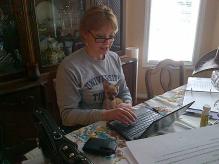 AB: I go slow and slow=better. Being my own boss now, I don’t feel the pressure to deliver a new book each year. I wish I could, but I find that if I take the time to send the manuscript out for editing by someone with cred and then shop the cover and blurb for feedback before going to print, I get a more effective piece of work; effective in the sense that I don’t have the goofy spelling errors (pore and pour—OMG!) or awkward paragraph splits to name a couple. It really takes time to catch these things. That means, no more rushing.
7.
Switching gears a bit, what is the one thing you tend to work into your book when possible?
 AB: There are two things that have been there from the get-go. The first is the oft complained about omniscient narrator. Dunno why poor omni is disliked. For me, omni entertains as I create, dropping dollops of knowledge onto the reader above what the characters know. I just love having secret knowledge and sharing that with the reader. The second thing readers will find is treachery of the old Byzantine kind. I’m a history nerd, and old Byzantium—fair or not—is renowned for its ability to hatch incredibly complex plots with ease. I don’t write complex plots per se, what I write are characters who are either complex and don’t know it or presume to be complex and aren’t but credit themselves with being crafty. That’s fun stuff to write and it’s going to be there every time.
 Lexi: I like to show that my lead females are not in need of being rescued, but are looking for an intimate partnership. One that makes them stronger and helps both characters face some sort of challenge and to do so by finding the strength in their love.
I also like to work in characters big or small that we all have met in our daily lives (judgmental relative, snippy boss, big personality, etc.).
A good plot with some sweet or hot romantic moments.
8.
What is the most rewarding aspect of publishing without a publisher/traditional (indie/smaller house)?
 Lexi: I deliver the exact book I envisioned on my terms.
 AB: That’s easy: getting to know the other side of the business. I can say this without exaggeration. After getting my first book to market under the new imprint, I was left with the feeling that writing the book was the easy/fun part. The steps required to deliver a quality piece of work (now called “the product”) were numerous, involved and filled with “either/or” choices. I’m looking forward to smoother sailing on the next ones, but that, I’m pretty sure, will take some more time to get to. Learning. Never. Stops.
9.
What is one aspect of indie publishing you did not expect?
 AB: The speedy turn around time with the printer for paperbacks. Learning the formats for all the digital platforms was so all-time consuming that I just assumed that printing would take weeks. It doesn’t. It takes days. But knowing this, I had to slow right down. I had to make sure that the pdf format for the printer was pristine. Sure, they run a preview copy, but I can’t allow myself to get it wrong. That would be a waste of precious paper. It must be absolutely ready to go before I send it to the printer. Turn around can be as fast as 48 hours for a small run.
 Lexi: All the work and research that goes into every aspect, especially promoting. When going at it as an indie, even with a publisher’s backing, you have to promote, promote, PROMOTE.
10.
In what way have you stretched yourself as a writer recently?
 Lexi: I write goals daily/weekly and stick to them (writing, promoting, and connecting with readers).
 AB: My first six books are blended genre pieces that embrace satire fiction and dark humor. Some, but not all, veer into a literary stream, but that’s more because of the characters’ inclinations. For example, the hopeless romantics go on and on about the trees and what they mean, while the egomaniac sees the end of days when the squirrels arrive.
Blended genres are a joy to write, but it’s not always easy to find the audience for them. In fact, it takes years of work to do that. So, for a change, I’ve decided to give pure genre a try. My first mystery, Self-Defense from the Kirsti Brüner Mortuary Mysteries Series, should come out later this summer. It’s kind of a funeral directors drum up business whether the business likes it or not scenario. There’s some grit as well as some laughs to be found in it.
11.
What is the one thing readers should know when reading one of your books?
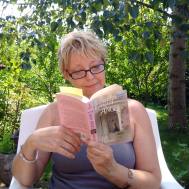 AB: Know that I write because I enjoy it and I have a lot of fun doing it. Approach the work with an open mind. Characters, like people IRL, don’t always tell the truth and they won’t go out of their way to help you figure them out. But do know that by the last page, all is explained. It’s important to me to give that.
 Lexi: First, thank you for reading it. Second, I hope you connect with it and can see yourself in the story. Third, I have more books due out soon! Four, strap in and enjoy the ride! And finally, there are sure to be a lot of fun, blushworthy, and intense moments. It will be rewarding!
About
Lexi Miles currently lives in California, has one sister named Cat, and is a proud pup mom of two mischievous Yorkies. Tropical warm spots and out of the way ranches are Lexi’s favorite escapes. Lexi loves to giggle. She’s a huge fan of positivity, and she is delighted when she can help someone else smile. Lexi loves a good in home TV/movie binge. She also enjoys music (all genres), baseball, bubble baths, cooking, and long walks on the treadmill (aka working out). As far as writing, she fell in love with it from when she was a kid, and she still finds that she falls more in love with it every day. Lexi is growing a cult following for both her poetry and romance novels (sweet to alarmingly spicy) and believes that love—all forms—is the most precious gift that we are given in life. She is thrilled to pen romance (multiple published titles), and all of that comes with it on paper! To find out more about Lexi, please go to www.LexiMilesAuthor.com.
Toronto born author A.B. Funkhauser is a mother, mortician and monkey who favors cats but still loves dogs. Dedicated to spreading the word on matters serious, she believes that the best way to get a point across is with a hefty dose of humor. Her fourth novel, SELF-DEFENSE, is the first in a mystery series headed by intrepid mortician Kirsti Brüner. For more information, please visit her Amazon author page and this site.
Proud Supporter


 On the run from his criminal family, Daniel Dayton returns home to Newcastle Upon Tyne when his abandoned daughter is attacked.
 Shaun didn’t always live in a damp cottage in Scotland. He once unwittingly lived in a flat beneath a white supremacist. He wasn’t always a writer, either. He worked in a factory, a government institution, as a manager in a purchasing department and later as a gardener.


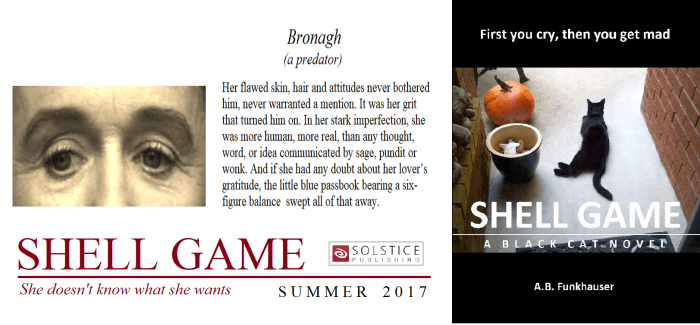
 As a ‘thank you’ to everyone who ever believed in my crazy plan to quit work and write full time, I’m offering SHELL GAME for FREE for the first three days of it’s release. THANK YOU, THANK YOU, THANK YOU! ❤
 About the Author
 Cryssa Bazos is a member of the Romantic Novelist Association, the Historical Novel Society, the Writers’ Community of Durham Region and the Battle of Worcester Society. Her articles and short stories have been featured in various publications, both in Canada and the UK. She is a co-editor and contributor of the English Historical Fiction Authors site and blogs as the 17th Century Enthusiast. Her debut novel, Traitor’s Knot, placed 3rd in Romance for the Ages in 2016 (Ancient/Medieval/Renaissance).
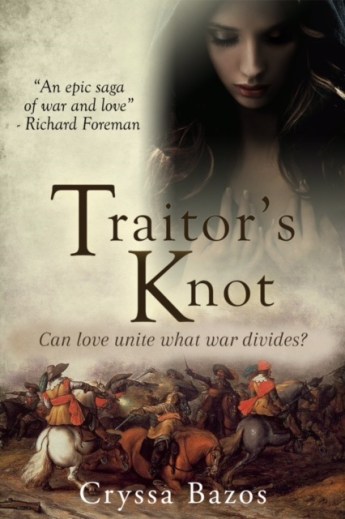 “A thrilling historical adventure expertly told.” – Carol McGrath, bestselling author of The Handfasted Wife
 new order, she risks her life by sheltering fugitives from Parliament in a garrison town. But her attempts to rebuild her life are threatened, first by her own sense of injustice, then by falling in love with the dashing Hart.

 Two envelopes. Two holocaust survivors. Two anonymous bearer bonds each worth one million pounds. Corporate forensic investigator, Cydney Granger, with help from beyond the grave, enters a world previously unknown to her to unravel the truth behind a web of secrets, lies, corruption, blackmail and hidden Nazi loot as new horrors of the Third Reich come to light.
 PR – Karen is represented by Midas PR in London
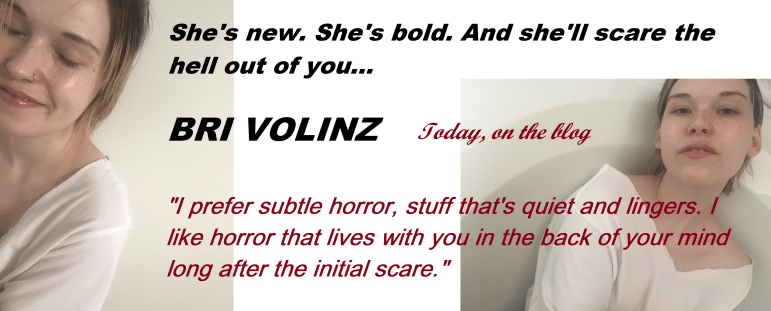
 Bri Volinz and I met by chance through a cat. That’s right, a cat. He appeared one day about three years ago at my back door looking suave and charming with appealing eyes that quickly won me over. My children, of course, wanted to keep him, but I knew he belonged to another. (The bell he wore around his neck was the clue.)
 Am I? Thank you for the reminder ha ha. I suppose I am a writer, or playing at being one at least. It’s the only passion I’ve ever pursued, and writing really is a labour of love for me, emphasis on the labour. It’s exhausting! It’s like going to the gym: pushing yourself to go is the hardest part, but the payoff from the workout is always worth it. And with writing, I can drink a beer and don’t have to wear pants while I work, which I can’t do at the gym. Trust me.
 because I love nightmares. The only thing that keeps me awake at night is my anxiety, which is something I want to explore more in my writing. I’ve got a couple fetus stories (not stories about a fetus, but stories in the early development stages, just to clarify) about my fears blown up, but nothing concrete.
 at the kitchen door, as if summoned by my thoughts of him. We started as roommates in a windowless basement apartment, where Kobe focused his energy on squeezing into holes in the drywall or escaping out the side door between the legs of the pizza man. Without a word, he was sending me a message: Let me go.
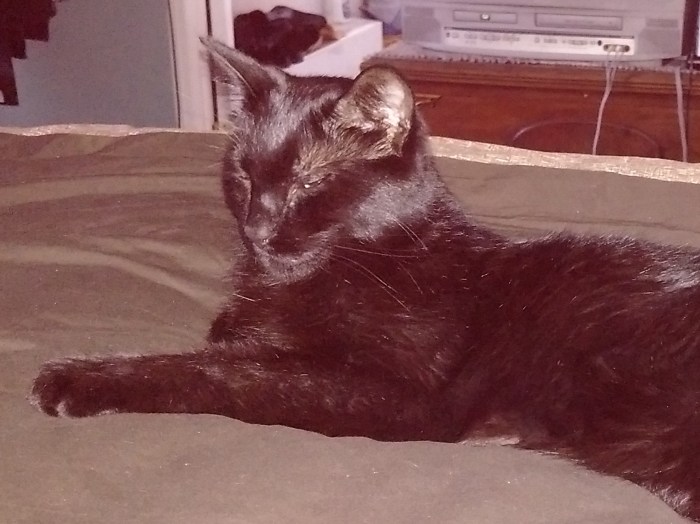
 Kobe met A.B. before I did, though her home is closer than our mailbox. A writer who, at the time, did not consider herself a cat lover, she fell hard for the feline (tall, dark, and handsome works for cats too). Kobe changed both of our lives, inspiring Funkhauser’s writing, and gifting me a mentor and dear friend.
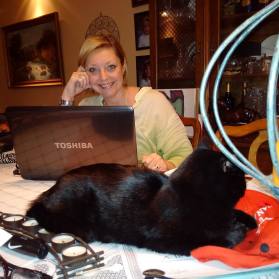 missed. He shows up when he is least expected, but most needed, providing comfort in the touch of his fur and a silence that says: Lay it all on me. At times Kobe is stingy with his affection, but he is just guarding his truth, keeping we humans guessing. We must remember that a cat’s trust has to be earned, like a blue ribbon to be pinned on the wall.
 and rarely have the focus to finish anything. One story I’m playing with revolves around two sisters, autism, guilt, and a closet monster. I’m also working out the logistics for a small webcomic about a slime princess and her wannabe Prince Charming, all done in MS Paint. I’m eager to see if either project reaches an ending.
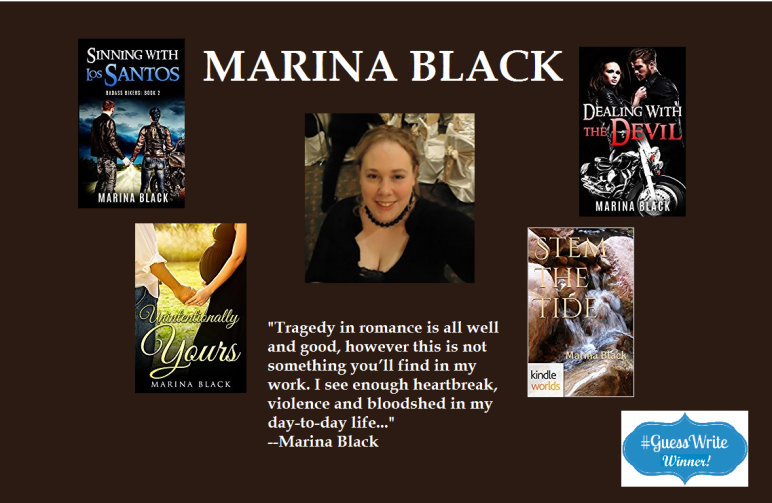
 at work, I like to keep my thoughts separate from my occupation. On a daily basis I deal with the critically ill, distraught, and dying. Coming home, I write romance to escape and as a coping mechanism. It’s a really great way to unwind! The second reason I prefer not to focus my writing on medicine is: as a nurse, if you didn’t chart it, it didn’t happen. I find myself compelled to write in gritty detail of each and every assessment my patient—character—might encounter. I have a very lovely beta reader who reads everything and tells me when I’ve gone too far into detail. Trust me, it’s quite often!
 I write contemporary romances. It just so happens that I also enjoy the suspense elements sprinkled in with my romance; it gives my novels some extra pizazz! My Badass Bikers series and upcoming novel Bargaining for Blood have a mystery, dramatic storyline that runs parallel to the romance. For Unintentionally Yours, there is no mystery or suspense involved—unless you’re wondering if they will or won’t live happily ever after!
 work. I see enough heartbreak, violence and bloodshed in my day-to-day life—I’m not looking for that when I’m reading or writing! Certainly ‘happily ever after’ eventually will come to an end for one reason or another, but you won’t find it in my work. I’m a big fan of the ‘happily ever after’.
 Motorcycle Clubs and a set of characters. After the book came out and people were reading I kept getting readers asking me about Cecelia and Danny and if their story was next. So, as an author I started thinking about them and that’s when SINNING WITH LOS SANTOS came into play.
 Losing Charlotte left a deep chasm within Bellamy Blake. It was the kind of hole that could only be filled by Clarke Griffin. This story chronicles the soul-binding love of two people who are destined to be lovers and leaders, despite the odds.
 The battle for control rages deep within the heart of New Orleans. While Hayley seeks to comprehend what it finally means to have a family, Niklaus must fight a thousand years of darkness to find a shred of humanity. The bond of blood runs deep…family, love, loyalty. All will be tested as two unlikely lovers come together. Will they find happiness or destroy one another?
 The treatise between the Grounders and the Sky People is a tenuous one. Danger lurks around every corner and war is imminent. Against all odds, Murphy befriends a young orphan and catches the eye of the Commander. For the good of their people, sacrifices must be made…the choice was almost too easy.
 The road to perdition is fraught with violence, anger and heartache. The way back to redemption is twice as bad. John Murphy lost his way in the world long ago. He vowed to numb the pain with bloody revenge. But she was the only one who wasn’t there to watch him hang for a crime he didn’t commit. Hurting her was never an option…
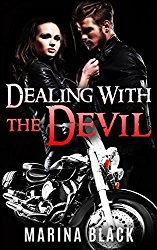
 Marina Black was born in the state of Connecticut. She is a busy registered nurse who works at a bustling inner city hospital. By night (and the occasional weekend), she is a prolific writer who has penned many short stories and works of fiction over the years. Dealing with the Devil (August 2015) was her debut original novel and Book 1 of the Badass Bikers series. Unintentionally Yours (November 2015) is a fan favorite! Sinning with Los Santos: Book 2 of the Badass Bikers series is on sale now! For author updates, follow Ms. Marina Black on Amazon, Facebook, and Twitter!
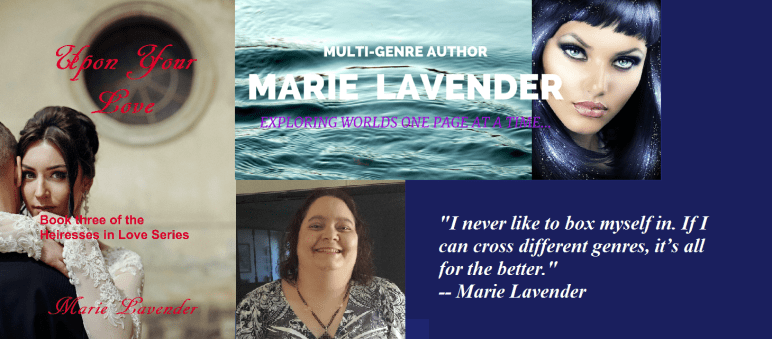
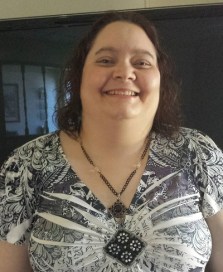 Please welcome back to the blog, crowd-pleaser Marie Lavender. With a shiny new release out, Marie takes a pause to answer some questions about multi-genre writing and staying outside the box. Oh! And she has a WIP on the go too. Hey, Marie.
 I actually prefer to define myself as a multi-genre author because I’m truly all over the place when it comes to the type of books I write. After releasing a children’s fantasy in 2015, I took a hard look at my works-in-progress, and then realized I needed to make a change instead of just calling myself a romance author. Some of the stories I have planned are dystopian or have time travel themes. I’ve even tried my hand at horror. Compared to some of the romance stories I’ve written, it was just easier to term my work as multi-genre.
 while balancing careers. And who hasn’t accepted a not so great job just to make ends meet? Obviously, some of the challenges Adrienne faces as a woman in Victorian New Orleans aren’t quite as relevant, but I think readers will quickly see she is a formidable character, and will appreciate that she knows what she wants. Shouldn’t we all be so self-aware? Besides, she quickly became a female quite out of her time as I grew to understand her during the writing process. I believe the audience can easily picture the heroine in the present day, making her own mark on the world.
 I always gauge these things based on the character’s strengths and fears, things deep in his or her background which can influence what happens. The plot forms from there. For one, I believe society usually interferes with the HEA (or, Happily Ever After) in romance. That especially occurs with historical romance. Modern settings are a different animal entirely. Secondly, events or yes, villains often prevent the characters from finding their happiness. To me, every story is different. Every character is different too, so it all depends upon the subtle nuances you discover as the tale progresses.
 Adrienne is the one rated most likely to be stubborn and act as unladylike as possible, to forge her own path, in a sense. But I do not think any of them are weak. If a reader reads the series from the beginning to the end of the trilogy, he or she will notice how these characters grow as capable women in a time when females don’t have much power at all. I even admire the ones that aren’t mentioned in the blurb; Claudette Giroux has a quiet kind of strength, which, of course, appeals to Eric Caron.
 The Hill family saga concludes as loyalties are questioned, faiths will be tested and undying love may come at a terrible cost…
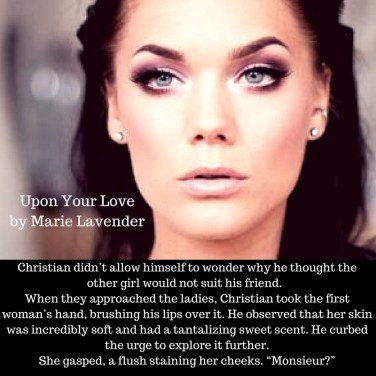
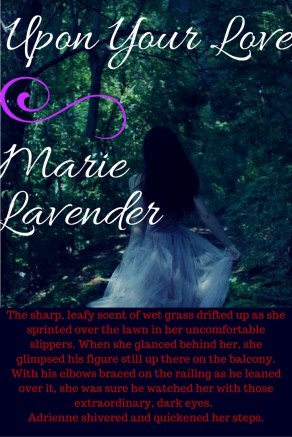 effectively put her back right up against a nearby tree. She cursed. Christian closed in, blocking her in with his arms as he braced his hands on the tree trunk. Her breaths came out in harsh pants and her stomach had fallen somewhere at her feet. Dear God, what would he do? She jerked her arms out to break his hold, but his muscles were like the ratlines between the shrouds of a mast in a ship’s rigging. Solid. Struggling with his obvious intimidation of her, she managed, “Why are you trying to kidnap me?”
 A. B. Funkhauser, Author