GUILTY PLEASURES: THE ONE’S THAT STICK

Many years ago, I hooked into a public television series that brought to life the detective novels of Dorothy

Ian Carmichael as Lord Peter Wimsey

L. Sayers. WHOSE BODY? CLOUDS OF WITNESS and UNNATURAL DEATH to name a few brought we, the devotees of Masterpiece Theatre and MYSTERY!, face to face with an immaculately dressed, preternaturally wealthy English nit named Lord Peter Wimsey. Fussy, feckless and a bit grating in his dedication to detail, he was the ideal sleuth, rambling freely against a background of country houses, ornate gardens and immaculately tended lawns. Fans couldn’t get enough of him and neither could his creator Sayers, whom aficionados said was actually in love with her creation.

Lord Peter might not be my type, but I certainly get the notion of a writer getting more out of the character than mere words on the page.

A lot of people have asked me where Jürgen Heuer comes from, and my answers vary, depending on my mood. Yes, he’s a work of fiction, but every fiction, to paraphrase Ian Fleming, “is precedent on some kind of fact.”

Rhett and BelleHeuer, like Sayers’ Wimsey, is incredibly real, although I doubt very much either she or I would make it through a meal with him without an outburst or two. Maybe it’s a condition of what inspires. The bad, the badder, the really, really broken. Good guys—perfect guys—just don’t pack the same punch. Heck, even Rhett Butler hung out at Belle Watling’s house of extraordinary extra circular activities, and NOBODY held that against him.

I did not set out to warp Heuer as much as I did. In fact, he plays rather nicely in the opening chapters of THE HEUER EFFECT which traces his early life. But there was something about the later man, the mature man, that courted the darkness. He’s been through the wars and has been affected by them, such that he screamed “go darker” and so I did.

simcoeThe idea that the bad side of a character is more compelling than the good follows me to this day: The anit-appeal generated by the real life figure of Capt. John Graves Simcoe on AMC’s excellent TURN: Washington’s Spies, is a case in point. Excellently portrayed by actor Samuel Roukin, Simcoe wreaks havoc among Republican forces in Setauket Long Island, hangs innocents without a blink, and composes creepy love sonnets to a winsome lass who’d shoot him herself if she could. And all the while, the lanky red coat finds time to prep for higher office north of the border as the First Lieutenant Governor of Upper Canada. (True stuff and crikey, we even named a lake and a civic holiday after him.)

It’s not the rich sets, protagonists and dialogue that brings me back. It’s Simcoe, and it pains me to say so.

Likewise, there’s the affable, ne’er do well Saul Goodman from BETTER CALL SAUL, another AMC sauloffering on hiatus after just ten episodes. Unlike Simcoe and Heuer, Saul is sweet, rubber faced and apologetically dishonest. With every bad deed, Saul struggles to do good and we love him for it. But each time he backslides into the old life—that of Slippin’ Jimmy from Cicero, Illinois—we’re on our feet, cheering. Shame we know how it ends: Saul is a prequel to BREAKING BAD. But the end’s not the point. It’s the “how” of the getting there that does it.

Heuer’s story isn’t over yet. The third book in the series “Unapologetic Lives” offers hope. But given this writer’s penchant for her creation, redemption is highly unlikely.

Salut, D.L. Sayers

ON PROVENANCE: WHAT MAKES HEUER TICK

Who we are and what we are depends on how honest we choose to be. At least that’s how my character Jürgen Heuer (pronounced ‘lawyer’) likes to play it out in life and death. Born in Bremen, Germany with summers spent in the Austrian Tyrol he is literally preprogrammed to be a romantic.

His mother, a dreamer raised on Schumann, palinka shots and weeping Hungarian violins demands it. “Love, my love, and desire—Sensucht—longing: These are the things that make the history, the things upon which great legends are built. Without these, you have dust in your mouth.”

wandern

Yet Heuer’s love for things musical “the cicada’s song” or lyrical “… her tangs of violet commixing with scents of must, like the old place back home in Europe” are squelched by history and a profound belief that he is “born bad” and cannot undo it.

“Small, both in mind and body, he had tremendous appetites, all of which skewed towards becoming more than what he actually was.” An apropos description not of the man, but of the father, Werner, whose tastes “… classic in [their] narcissism, embraced the moldy old ethos of ethnicity over geography, and, as such, he was first in line when Anschluss came to Vienna…”

anschluss1

Werner Heuer has no time for art or music: “For him, the rhythmic tapping of jackboots on pavement went beyond forced occupation; it was the end of the road after a long trek.”

Eschewing his parents’ hang-ups, Heuer does his best to build a life in America that is, by all accounts, immensely successful and hardly lonely. But it is contrived. Dodging promotion, cruising the outer banks that frame society, he keeps to himself, except when he toys with the lives of others. When a young colleague joins the firm Heuer takes action, not swiftly, but slowly, the way he likes it: “The decision to ruin a young man half his age was taken lightly and on purpose, as if giving weight to the decision conferred unjust power on the youth. To Heuer, it was personal, but also a test to see if he could actually do it.”

All business, Heuer reminds me of another character, Irmtraut Weibigand, currently under construction in POOR UNDERTAKER, a work in progress. A woman of business, she wrestles with secret doubts about the veracity of her citizenship, place in the community, and the integrity of the people she tries to call friends. A raucous Chamber of Commerce luncheon exacerbates this, when she rises in defense of her frenemy Hartmut Fläche, whose effete manners and pomposity alight the simmering hatred of fellow Chamber member Conrad Hickey. Defending Fläche’s right to exist, Irmtraut loses her cool as she’s reminded that she’s as ‘foreign’ as he is even though she has been a part of the community for nearly thirty years. Well read, she cannot help but think of Shakespeare’s monster Caliban from the Tempest making a subtle but conscious comparison to her own place on the ‘island’ that is Portside, Michigan. Thinking back to her mother, her provenance and her roots, she is cut at the knees, reminding herself that no matter how fine she becomes, she will always wear homespun.

Like Irmtraut, like Werner, Heuer wrestles with his identity which takes centre stage anno domini. His inane Germanity  no longer an issue, Heuer wishes only to be cared for and remembered.

FOLLOW THE BLOG TOUR BEGINNING APRIL 20 THRU MAY 18

Heuer Lost and Found Banner 540 x 200

bewitching_header

http://bewitchingbooktours.blogspot.ca/

Can a fly interview a rat? Malay Upadhyay thinks so. Funkhauser doesn’t argue.

It was with great pleasure that I appeared recently on fellow Solstice author Malay Upadhyay’s blog AUTHORZ & CHARACTERZ in support of the upcoming release of HEUER LOST AND FOUND. Photo - Malay UpadhyayYou may recall that Malay was featured here recently to promote his work Kalki Evian: The Ring of Khaoriphea. Like yours truly, Malay has no problem whatever assigning qualities magical and mystical to humble creatures. In that spirit, he endeavoured to interview me IN CHARACTER; in this case as the incomparable Rat, whose influence in Heuer’s funeral parlor exceeds what one might normally expect. Reproduced today…

Interview with A. B. Funkhauser

Hallo, guyz! Today we are going to teeter around a deathly zone – a fine line between thiz and that world. Az our ezteemed guide, we have A. B. Funkhauser, a funeral director cum wildlife and clazzic car enthuziazt from Ontario, Canada.

Zhe takez uz through her debut novel, Heuer Lost And Found – which combinez Adult, Paranormal and Dark Humor in a fiction – az a rather unexpected creature.

Fly: Welcome, Mz. Funkhauser. I zee you are in a different mold today.

AB: You bet, Fly. Rats have a nasty reputation, but there’s more to me than good looks and an above average competency in Latin. We are clean, clever and very friendly, which is why my life and death in HEUER LOST AND FOUND is celebrated favourably by most of the characters.

Fly: That’z awesome! If it’s any support, flies get a bad rap too. But here we are in a funeral parlor. What’s new?

New Funkhauser ShotRat: Silent. More than usual. The guys – Enid and her manager, Charlie – are trying to make ends meet because deaths have been few and that has robbed them of their payroll! Heuer’s death, while hard on Enid, was the first death call in weeks. He really saves the day.

Fly: I find a zcary zenze of irony in all this! But let’z talk about the novel. Heuer Lost & Found beginz with the death of Jürgen Heuer. How did your alter ego come by that idea?

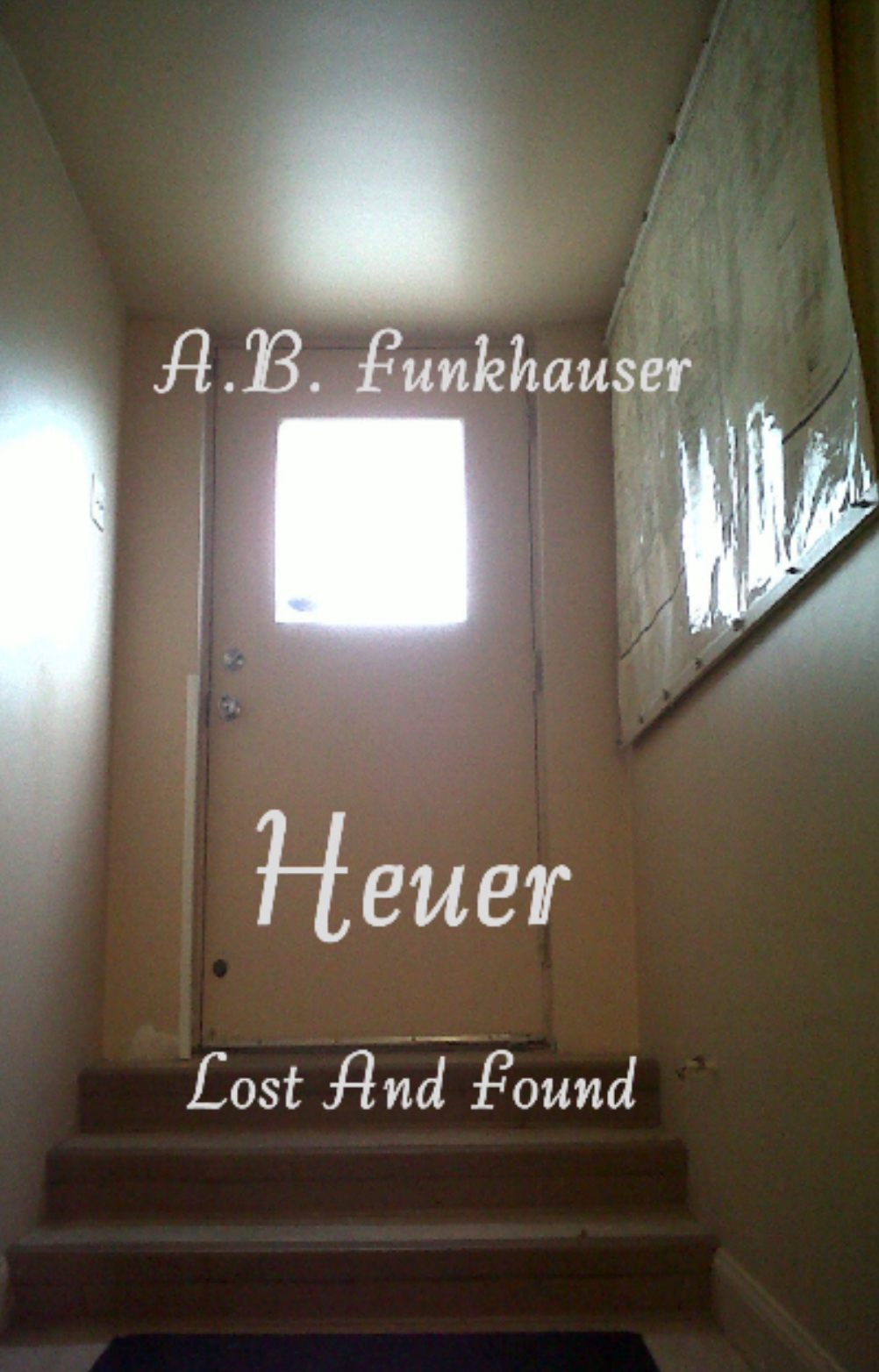
Rat: It was in the winter of 2010, and after a long day at the funeral home she looked down the long hall joining the director’s office to the back door leading three steps up and out into the parking lot. The back door on the cover is a more than accurate representation of it. It’s from a real funeral home, you know? Anyway, a thought occurred to her at that moment: What if a slightly life-challenged mortician tripped over her man shoes and landed squarely on her posterior, only to learn that someone she once knew and cared about had died, and that she was next on the staff roster to care for his remains? Freaky, no? But there it is Ad infinitum

Fly: Tell uz about Heuer?

Rat: Beyond a word rhyming with “lawyer,” Heuer the lawyer is a very conflicted man. Intensely private, heElevator - Copy craves recognition, but doesn’t want anyone to get too close. When he finds my shattered body on the floor of the Wisteria Slumber Room, he approaches, commenting on the exceptional beauty of my fur. At that moment, he recognizes beauty in an unlikely thing. I found this particularly charming about him. I must confess, however, to being more than a little put out when he confronts my murderer. I had great hopes for moral redress; instead, he takes pity and tries to help her. What can I say? Ecce homo.

Fly: That’z exciting. Where can the readerz get accezz to theze?

Rat: Through Amazon.com .ca .co.uk Bookgoodies and the publisher www.solsticepublishing.com. Here are some buy links:

Buy Link (United States)

Amazon Link: http://www.amazon.com/Heuer-Lost-Found-B-Funkhauser-ebook/dp/B00V6KLAMA/ref=sr_1_1?s=digital-text&ie=UTF8&qid=1427367625&sr=1-1&keywords=heuer+lost+and+found

Buy Link International (Country specific Amazon sites)

Book Goodies: http://bookgoodies.com/a/B00V6KLAMA

https://www.goodreads.com/book/show/25232328-heuer-lost-and-found?from_search=true

Direct buy presale link (United States): http://www.amazon.com/s/ref=ntt_athr_dp_sr_1?_encoding=UTF8&field-author=A.B.%20Funkhauser&search-alias=digital-text&sort=relevancerank

Also, information will be posted as it becomes available on her website www.abfunkhauser.com and her author page on Facebook www.facebook.com/heuerlostandfound. I believe she posted a most excellent profile of your alter ego there, Fly. (laughs)

Fly: Zome inspiration that. What would you zay haz inzpired A.B. Funkhauser in real life?

Rat: She has an amazing support group—her family, her writer’s group The Brooklin 7, and pretty well everyone she comes into contact with, from friends at the grocery store and local coffee house to the lady who helps her with her printing at Staples. She also maintains close connections to friends and work colleagues in funeral service, a business I must say that can easily be misunderstood with little effort. She believes in the work, and through writing has tried to shine a light on it.

Fly: And any author or artizt can vouch for how important thoze things are. Working as a funeral director, what iz Mz. Funkhauser’z take on life?

Rat: Like most funeral directors, she is governed by a strong sense of altruism fueled by the belief that life chooses us and we not it. She celebrates it daily, from simple chores to writing new chapters. And she loves the outdoors. It’s been a long winter here in Canada. She needs to get outside and roam.

Enid - CopyFly: In the ztory, we have Enid on one zide, who lozez zomeone important to her – Heuer – without a chance to zay a final goodbye. On the other zide, we have Heuer whose ztory, and in zome way, life itself unfoldz after hiz death. In a zingle ztroke, you introduce uz readerz to both our greatezt fear and our greatezt wizh!

Take uz through thiz experience with regardz to getting zecond chancez in life. Which perzpective would you zay you lean more towards in real life?

Rat: The first thing Funkhauser got rid of after her thirtieth birthday was the idea that all she had in front of her was second chances. She decided instead to roll with the idea that it’s all a continuum…good days, bad days, successes and failures. She refuses to see the end. She sees the next day and all the promise that comes with it. On a micro level, if she suffers less than three disappointments in a day, it’s been a pretty amazing day!

The character Heuer in life goes through the motions of working and acquiring “stuff”. His house is literally packed to the ceiling with ‘treasures’ signifying a life in progress. But there is no real human contact. He avoids his neighbors wherever possible, does not have a spouse or significant other, and lives through what he sees on the television and in old photos. After death, being found is prime to him because his objects can’t call for help, and there is no one out there looking for him.

On the opposite end of the spectrum is Enid. She has done everything her society expects of her: she has a career, a spouse, family, friends and hobbies. But her life is changing. Her eyesight is blurred; her step, less sure footed. “There is unfinished business here,” Heuer says, and it’s to that business that the book turns; so not so much a second chance, but a recognition that the drama and comedy are still continuing.

Fly: That anomaly iz a work of art! I have to bring up a literal one at thiz point, though – The Lamp. Very much living, myzteriouz and absolutely fascinating! Care to introduce uz to it?

The Lamp embodies the spirit of the funeral home matriarch who died decades before. Anchored to the floor by her griffin’s feet, she can travel in the minds of others, but cannot leave her place in the dusty, cramped funeral home basement. There is a parallel here; that her domicile closely resembles Heuer’s and that their predicaments are similar. It was inevitable that the two should become allies, although their relationship is a strained one.

Fly: And you embody one of them?

More Heuer, I think. As I said earlier, rats have a bad rap owing to history and human malfeasance. The same is true for Heuer. He carries with him the sins of his father. Just by being born, he is convinced that he is bad, and rather than try to overcome it, he embraces it in his twenties. The tragedy for him is that his life is a lie and all the angst that ruled him in life was completely without merit.

Fly: Alright, don’t say anymore! I can barely control my urge to flip through the pagez right till the very end. When doez the book come out?

Rat: It hits all the AMAZONS April 23, 2015. Presales began March 26, 2015.

Fly: Time to mark our calendarz then. For now, we make do with the preview. Thank you, dear Rat, for your attendance today.

Rat: You can call me ‘The’. That’s my first name.

Fly: Really?! Mine too! Damn, what are the chances??Rat

Rat: (laughs) That’s my point, dear friend. You and I share the same hang-ups. Of course we’d align. Amicitiae nostrae memoriam spero sempiternam fore.

Fly: The Fly, mind you. It’s time to get out of the funeral parlour! And to all the readerz, enjoy the excerpt from Heuer’z pozthumouz world!

Happy living,

The Fly

It's happening April 23, 2015
It’s happening April 23, 2015

 AN EXCERPT FEATURING “RAT”

Rat should have seen it coming. He was a rat after all and therefore genetically predisposed to a shorter life. As such, he should have taken better care. But tender concern for his friend obscured his view, and this deprived him of a rodent’s perfunctory need to avoid detection.

Mrs. Emmy Shawson-Cooke-With-An-”E” late of The Springs by way of Baycon Hill had died quietly in her bed in her ninety-sixth year. Owing to her advanced age, her family decided that a little-more-than-this-side-of-nothing was required to get her on her way as quickly as possible. To that, arrangements were concluded between Teddy Shawson-Cooke-With-An-”E,” her great nephew and heir, and Charles Emerson Forsythe, funeral director extraordinaire.

“I’m very sad to hear of your great aunt’s passing,” Charlie said somberly, for he liked Emmy very much. A wealthy woman, she was a doyen, a neighborhood fixture, raising funds for world wild life, Christian children and Ethiopian famine relief. But she was more than just money. At the heart of her was a genuinely good human being who said what she meant, and acted on her commitments. In the early years, she was a constant fixture at Weibigand’s, resplendent in a magnificent suite of emeralds that Charlie never tired of commenting upon. “I bring in the business, don’t I Charlie?” she would say through cherry lips under a pillbox hat. Indeed she did, and Charlie encouraged her familiarity. Both shared a special bond. Even after her (some said) forced relocation to the nursing home in The Springs, she never failed to fire off emails to her Charlie to make sure he was okay. And Charlie always visited her on her birthday and at Christmas.

Emeralds? Rat was barely two years old and so had never met Emmy Shawson-Cooke. But he knew well enough about gemstones and other things too, and so it was to this that he turned his attention as he repositioned himself inside Charlie’s monk strap Prada slip on. They were in the front office, Rat’s favorite room by far. It faced the street, was pleasantly lit, and with its high coffered ceiling, offered stunning acoustical advantages. Charlie was reminiscing with Teddy about the gemstones: They sparkled blue at their centers, spanning outward only to be confined devilishly in beveled frames of seawater green. Spectacular—like the Bering Strait meeting the Caribbean Sea. Emmy’s late husband Cecil joked that they could shame Tsars and tease laughs from stone.

“I beg your pardon,” Charlie said noticing Rat beneath him. It was Charlie’s habit to remove his shoes in mid-afternoon to promote better circulation, but they were in the way now under the large desk and he took care not to disturb the Weibigand mascot as he moved the shoes off to one side.

Teddy Shawson-Cooke shifted from haunch to haunch, his incredible heft straining the pound for pound capacity of the Faux Toscano Victorian Rococo wing chair he was sitting on. Forsythe, sensing the man’s discomfort, did his best to speed up the meeting. Emmy had prearranged her funeral and Teddy was undoing as much of it as he could because, he said, “there was no one left” and “doing her up for nothing was just plain stupid.” Truth was, Teddy had the power to add the money saved from a cheapo funeral to his aunt’s estate, from which he could pay himself as executor.

Charlie smiled down at Rat who, in an act of implicit trust, dozed off in his shoe.

“Allow me, if you will, to think out loud,” Charlie said, in anticipation of what Teddy wanted to serve up next. If the meeting went on much longer, Emmy’s casket choice would be undone too and no one at Weibigand’s—Charlie most all—could bear to put Emmy into anything less than the mahogany she’d paid for years before. “Your great aunt put her faith in us to carry out her wishes. I understand where you are coming from, but I must insist on the single night of visiting she paid for.”

Shawson-Cooke, in saying nothing, red-flagged Charlie, and he picked up speed. “Now the emerald suite. I trust she will be wearing it, as always?” Teddy replied that it was “long gone” save for the ring which, he hoped, “found its way out of the nursing home before someone else got to it.”

Down on the floor below, Rat dreamed of Carla and, more particularly, her less than utterly no-good spouse Danny Blue—a musician in a band that had, in the space of two years, eroded the family fortune on protracted road trips through northern Canada. Designed to boost the band’s profile and hopefully springboard them into other gigs in Manitoba, the latest tour had bogged down south of Parry Sound and Danny Blue had forgot to come home. The issue at hand was money. Plain and simple. And in dreams, Rat searched for a solution.

Thank you Malay for your kind hospitality. All the best to you and much success for Kalki Evian.

Find it on Amazon, Barnes and Noble and Bookgoodies. Check out my review on Goodreads.

HEUER LOST AND FOUND: THE EXCERPT

“Come with me, and I will show you worlds.”


At last, HEUER LOST AND FOUND is ready to go with presales beginning March 26 to the launch on April 23rd on Amazon. It’s been a long, exciting journey marked with encouragement and a lot of learning. I’ve made so many friends along the way, so much so that I owe this space and the people that help fill it a special nod all their own. In the coming days, I’ll be talking up my ladies in the Brooklin 7, my incredible sister and authorly inspiration Cryssa Bazos, and long time friends Gilda Heinrich Rousseau and Suzanne Fairbrass Stacey. I will also pay homage to the crew at the Wine Rack, the guys on the Canadian Poncho Car site, and the amazing staff at the Pickering Metro; all of whom make stepping out the door an adventure. Thank you. I’d be remiss if I didn’t mention Solstice Publishing, it’s staff—who are also writers—and the amazing authors I’ve grown close to as a member of the Solstice Family. All in due time. Today, is for every person I’ve spoken to who expressed interest in HEUER LOST AND FOUND. I owe you an excerpt.

Chapter Two

Two Weeks Ago

The house, like the man who lived in it, was remarkable: a 1950s clapboard-brick number with a metal garage door that needed serious painting. Likewise, the windows, which had been replaced once in the Seventies under some home improvement program, then never again. They were wooden and they were cracked, allowing wasps and other insects inside.

This was of little consequence to him.

The neighbors, whom Heuer prodigiously ignored, would stare at the place. Greek, Italian, and house proud, they found the man’s disdain for his own home objectionable. He could see it on their faces when he looked out at them through dirty windows.

To hell with them.

If the neighbors disapproved of the moss green roof with its tar shingles that habitually blew off, then let moet_champagne_partythem replace it. Money didn’t fall from the sky and if it did, he wouldn’t spend it on improvements to please strangers.

They were insects.

And yet there were times when Jürgen Heuer was forced to compromise. Money, he learned, could solve just about anything. But not where the willful and the pernicious were concerned. These, once singled out, required special attention.

Alfons Vermiglia, the Genovese neighbor next door, had taken great offense to his acacia tree, a towering twenty-five foot behemoth that had grown from a cutting given to him by a lodge brother. The acacia was esteemed in Masonic lore appearing often in ritual, rendering it so much more than just mere tree. In practical terms, it provided relief, offering shade on hot days to the little things beneath it. And it bloomed semi-annually, whimsically releasing a preponderance of white petals that carried on the wind mystical scent—the same found in sacred incense and parfums.

What horseshit.

It was a dirty son of a bitch of a tree that dropped its leaves continuously from spring to fall, shedding tiny branches from its diffident margins. These were covered in nasty little thorns that damaged vinyl pool liners and soft feet alike. They also did a pretty amazing job of clogging Alfons’ pool filter, turning his twenty-five hundred gallon toy pool green overnight.

This chemistry compromised the neighbor’s pleasure and it heightened his passions, blinding Alfons to the true nature of his enemy. He crossed over onto Heuer’s property and drove copper nails into the root system. It was an old trick, Byzantine in its treachery; the copper would kill the tree slowly over time leading no one to suspect foul play.

weird vistaBut Heuer was cagey and suspicious by nature, so when the tree displayed signs of failure, he knew where to look.

The acacia recovered and Alfons said nothing. Heuer planted aralia—the “Devil’s Walking Stick”—along the fence line and this served as an even thornier reminder that he knew. And if there was any doubt at all, he went further by coating his neighbor’s corkscrew hazel with a generous dose of Wipe Out.

Intrusive neighbors and their misplaced curiosities were, by turns, annoying and amusing and their interest, though unwanted, did not go unappreciated. The Greeks on the other side of him weren’t combative in the least and they offered gardening advice whenever they caught him out of doors. The man, Panos, talked politics and cars, and expressed interest in the vehicle that sat shrouded and silent on Heuer’s driveway. He spoke long and colorfully about the glory days of Detroit muscle cars and how it all got bungled and bargained away.

Detroit GTO“They sacrificed an industry to please a bunch of big mouths in Hollywood,” Panos would rant in complete disregard for history: Al Gore and Global Warming didn’t kill the GTO; the OPEC oil crisis did. But there was no point in telling him that.

Panos was an armchair car guy and incurable conspiracy theorist. He also kept to his side of the fence, unlike his wife, Stavroula, who was driven by natural instinct. Not content to leave an unmarried man alone, she routinely crossed Heuer’s weedy lawn, banging on the door with offers of food and a good housecleaning.

Heuer had no trouble accepting her cooking. But he declined her brush and broom. Was it kindness, or was she trying to see inside? He suspected the latter.

No one was ever seen entering Heuer’s house and while this piqued public interest, he never gave in, not even to those who were kind to him. He liked Panos and Stavroula and he regretted poisoning their cat.

But not enough to let them in to his home.

Others on the street had less contact with him. Canvassers at election time would disturb him, in spite of the lawn sign warning the solicitous away. That this didn’t apply to neighbor kids brave enough to pedal cookies and magazine subscriptions in spite of the sign, was a testament, perhaps, to some residual soft spot in his heart that endured.

Even so, he knew that people talked about him and, frankly, he had trouble accounting for their fascination. Short, curt, bespectacled, he courted an ethos that favored enforced detachment. When people got close enough to hear him speak, they detected a trace of an accent. Now faded after years of U.S. residency, his speech still bore the unmistakable patterns of someone undeniably foreign. Elaborate, overwrought and heavy on the adverbs, he spoke very much like his neighbors. Yet the distance between them was incalculable…

***

Day 1: Post Mortem

Heuer shook his head, finding it especially odd that he would think of such things at this particular moment. The circumstances, after all, were beyond peculiar. Coming out of thick, dense fog, standing upright, looking wildly around, and having difficulty comprehending, the last thing that should trouble him was human relations.

The man on the floor would have agreed, had he not lacked the resources to speak.

Heuer canvassed his surroundings. The room, still dark, the shades drawn, and the plants Stavroula forced on him, wilted and dry, bespoke of an unqualified sadness. His computer, left on and unattended, buzzed pointlessly in the corner, its screen saver, a multi-colored Spirograph montage, interspersed with translucent images of faceless Bond girls, twisting ad infinitum for an audience of none.

Back StairWhat happened here?

The bottle of Johnnie Black lay open and empty on the bedroom floor, along with a pack of Marlboro’s, gifts from an old friend. The desk chair lay on its side, toppled, in keeping with the rest of the room. His bed sheets were twisted, the pillows on the floor, and there were stains on the walls; strange residues deposited over time representing neglect and a desire to tell.

He looked down at his hands. They kept changing; the veins, wavy, rose and fell like pots of worms.

Trippy.

There was no evidence of eating, however, and this was really weird, for it was in this room that Heuer lived. Flat screens, mounted on the ceiling and on the desktop, kept him in line with the world outside in ways that papers could not. Screens blasted twenty-four and seven with their talking heads and CNN, whereas papers were flat and dirty, suitable only for the bottoms of bird cages. He cancelled the dailies first and then the weeklies, seeing no value whatever in printed words.

Pictures were another matter. Several in paint and charcoal and sepia covered the walls and floors. He loved them all, and he stared at them for hours when he pondered. His beer fridge, humidor, and model rocket collection completed him; housing the things he loved, all within perfect reach.

His senses, though dulled, honed in on a scent, distant yet familiar, coming from inside the room. It was bog-like-foul like a place he’d visited long ago, buried under wood ash. He frowned.

What was the last thing he ate? Did he cook or go for takeout? He wanted to go down to the kitchen to check, but found, to his astonishment, that he could not get past the doorframe into the outer hall.

Nein, das kann nicht sein!—Now this is not right!—he fumed, switching to German. He would do this whenever he encountered static. The spit and sharp of it forced people back because they could not understand what he meant.

Unballing his fists he felt his chest, registering the sensation of “feel”—he could feel “touch,” but he could not locate the beating heart. Consciously knitting his brows, he considered other bodily wants, his legal mind checking and balancing the laws of nature against the laws of the impossible. He could not, for example, feel “hunger” and he wasn’t dying for a drink either.

Was this a mark of passage into the nether? The man on the floor had no comment.

He thought about his bowels and if they needed attention, but that, to his great relief, no longer appeared to matter. Regularity, in recent years, wasn’t all it was cracked up to be. When he was young, he reveled in a good clean out after the morning coffee because it reset his clock and established the tone for the rest of the day. Not so latterly. His prostate had kept its promise, letting him down, enlarging, pressing where it ought naught. Awake most nights, he lost sleep and dreams.

With this in mind, he bounced up and down on the soles of his expensive shoes in an effort to confirm if he was awake or not. Perhaps he was sleepwalking, or heading off to the can for another urinary evacuation that wouldn’t come?

The man on the floor ruled out these options.

He tried the door again, and again, to his dismay, he could not leave.

What to do? What to do?

‘I think, therefore I am,’ went the popular saying, but what good was ‘being’ when one was confined to a bedroom like a rat in a cage?

He struggled to remain calm, just as he became aware of that heavy oppressive feeling one gets before receiving bad news. Pacing back and forth across the ancient floorboards in the house he was born into, he checked for the kinds of incriminating evidence the court of public opinion would hold against him once found. Pornography, loaded handguns, too many candy wrappers all had to be dispatched before someone inevitably broke the door down.

As light turned to dark and day gave over into night, Heuer’s thoughts came faster and faster, in different languages, interspersed with corrugated images, accompanied by generous doses of Seventies rock; a fitting sound track for the old life, now ended.

He fell to his knees. Somewhere in this mélange was something to be grateful for and with time, he was sure, he would figure out what that single, great, thing might be. For now, all he could really do was take comfort in the fact that his death had been perfect.

***

See the first trailer  https://www.youtube.com/watch?v=f3beUBWf2CQ

Definitely see the NEW ONE

Interview Part 1: https://www.youtube.com/watch?v=g2yhaXfh-ns

Interview Part 2: https://www.youtube.com/watch?v=WoPthI1Hvmo

BUY LINKS:

Preorder Link: http://www.amazon.com/s/ref=ntt_athr_dp_sr_1?_encoding=UTF8&field-author=A.B.%20Funkhauser&search-alias=digital-text&sort=relevancerank

Amazon Link: http://www.amazon.com/Heuer-Lost-Found-B-Funkhauser-ebook/dp/B00V6KLAMA/ref=sr_1_1?s=digital-text&ie=UTF8&qid=1427367625&sr=1-1&keywords=heuer+lost+and+found

Book Goodies: http://bookgoodies.com/a/B00V6KLAMA

Thank you. 🙂

Advance Review of Heuer Lost and Found

No stranger to this blog, author Bernard Foong (A Harem Boy’s Saga I, II, and III) had a look, and in advance of Heuer’s debut April 23rd, here’s what he had to say:

5 star review:

Author A. B. Funkhauser strikes a macabre cord with her book Heuer Lost and Found”.

Written from

Bernard Foong is an international best selling author.

the perspective of an undertaker, she gives her readers a ringside seat at the Weibigand Mortuary where Enid, a middle aged woman with a taste for scotch, arrives on a Monday morning still in a stupor from the night before. Initially, the reader learns a bit about Enid and the history of the mortuary, its original owners and their heirs who continue to operate the family owned business, along with all of its eccentric employees. Early in the day, a call is received and there after a not so typical day in the life of a mortuary begins. Heuer, a well known middle aged attorney has been found dead in his apartment, where he laid for several days. The story now moves between present day and flash backs to a time when Heuer, Enid and others in the story are intertwined in one way or another. Heuer appears as a ghostly spectre to enchant us with his own take on his past, and his current impressions of what is being said and done as his body is prepared for burial. I for one like this book. I found it to have a similar feel to the HBO series “Six Feet Under”.

Ms. Funkhauser is a wizard with words and did a fine job of weaving this story of Greek, German and English speaking families that bounced back and forth throughout the entire book.

Hooray! And thank you, Bernard Foong.

Drop by #1lineWed for more Heuer and some excellent one liners from incredible authors. 🙂